Why Knee Pain Happens After a Car Accident
Key Takeaways
- 1
Knee pain after a car accident often worsens over time. Dashboard impact, sudden braking, and twisting forces can cause ligament tears, meniscus damage, fractures, or cartilage injuries that feel minor at first but become more painful as swelling develops.
- 2
Same-day evaluation prevents complications. Early diagnosis allows for proper treatment, reduces the risk of permanent damage, and ensures you receive care within Florida's 14-day PIP insurance window.
- 3
Imaging is essential for accurate diagnosis. X-rays detect fractures and bone injuries, while MRI or CT scans reveal ligament tears, meniscus damage, and soft tissue injuries that cannot be seen on standard X-rays.
- 4
Even minor crashes can cause serious knee injuries. The severity of the collision does not always match the severity of the injury—low-speed accidents can still tear ligaments or damage cartilage.
- 5
Delaying care risks your coverage and recovery. Waiting to get checked can worsen the injury, cause you to miss Florida's PIP deadline, and leave you without proper medical documentation for insurance or legal purposes.
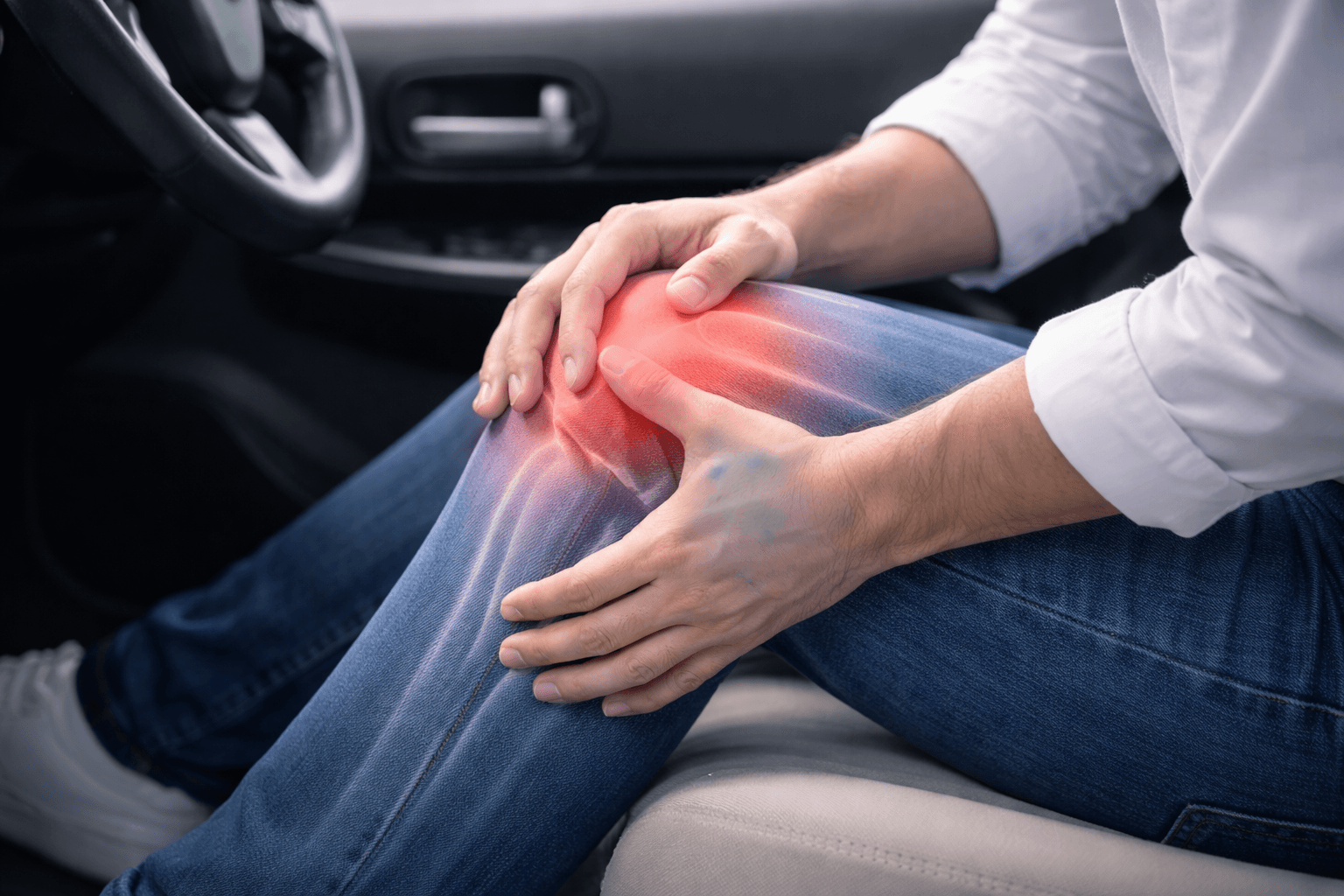
Knee pain is one of the most common injuries people experience after a car accident—even in minor collisions. Your knees are vulnerable during crashes because of dashboard impact, sudden braking force, airbag deployment, and the way your body braces for impact. What might feel like a minor ache at first can develop into a more serious injury that limits your mobility and requires medical treatment.
If you're dealing with knee pain, swelling, stiffness, or instability after a car accident, you should get evaluated the same day. Knee injuries can worsen quickly if left untreated, and early diagnosis ensures proper healing and protects your ability to walk, work, and recover fully.
This guide explains what causes knee pain after car accidents, what types of injuries are most common, when you need medical care, and why same-day evaluation matters—especially in Florida, where PIP insurance timelines and medical documentation can affect your coverage.
Why Knee Pain Happens After a Car Accident
During a car accident, your body experiences sudden, violent forces that your knees are not designed to absorb. Even if you were wearing a seatbelt and your airbag deployed properly, your knees can still sustain significant trauma.
Common causes of knee pain after a crash include:
Dashboard impact: In frontal collisions, your knees often slam into the dashboard or the back of the front seat. This creates blunt force trauma that can bruise bones, tear ligaments, damage cartilage, or fracture the kneecap (patella).
Sudden braking and twisting: When you slam on the brakes or swerve to avoid impact, your body twists while your feet remain planted. This rotational force can tear ligaments like the ACL or MCL, or damage the meniscus.
Hyperextension or hyperflexion: Your knee can be forced beyond its normal range of motion during impact. Hyperextension (knee bent backward) or hyperflexion (knee compressed too far forward) can strain or tear ligaments and soft tissue.
Airbag and seatbelt force: While airbags and seatbelts save lives, the force of deployment can push your body backward or sideways, causing your knees to twist, strike hard surfaces, or bend awkwardly.
Delayed symptom onset: Like many car accident injuries, knee pain often does not appear immediately. Adrenaline masks pain during and right after the crash. Swelling, stiffness, and pain typically worsen 12 to 48 hours later as inflammation sets in.
Even if you walked away from the accident without limping, knee damage can still be present—and it often becomes more painful and limiting as time passes.
Common Types of Knee Injuries from Car Accidents
Not all knee pain after a car accident means the same thing. Several different injuries can cause discomfort, swelling, or instability:
Knee contusion (bruised knee): Direct impact with the dashboard or seat can bruise the soft tissue and bone around your knee. This typically causes tenderness, visible bruising, and pain with pressure or movement. While less severe than fractures or ligament tears, contusions still require rest and monitoring.
Patellar fracture (broken kneecap): A direct blow to the front of your knee can crack or shatter your kneecap. This is one of the more serious knee injuries and causes sharp pain, inability to straighten the leg, visible deformity, and significant swelling.
Ligament tears (ACL, MCL, PCL, LCL): The ligaments that stabilize your knee can tear during sudden twisting, hyperextension, or direct impact. ACL and MCL tears are most common in car accidents. Symptoms include a "pop" sound at the time of injury, instability, swelling, and difficulty bearing weight.
Meniscus tear: The meniscus is the cartilage cushion inside your knee joint. Twisting or compression forces can tear this cartilage, causing pain along the joint line, swelling, locking or catching sensations, and difficulty fully bending or straightening the knee.
Knee dislocation: In severe crashes, the bones of your knee joint can be forced out of alignment. This is a medical emergency that often involves damage to ligaments, blood vessels, and nerves. Symptoms include severe pain, visible deformity, and inability to move the knee.
Soft tissue strain or sprain: The muscles, tendons, and ligaments around the knee can be overstretched or partially torn. This causes pain, swelling, and stiffness but is generally less severe than complete ligament tears or fractures.
You cannot reliably diagnose the type of injury based on pain alone. Imaging is the only way to know for sure what damage has occurred.
Symptoms That Should Not Be Ignored
Knee pain after a car accident can range from mild discomfort to a serious injury requiring immediate intervention. Seek medical care the same day if you experience any of the following:
Severe pain that does not improve with rest
Inability to bear weight on the injured leg
Visible swelling around the knee or kneecap
Bruising or discoloration across the knee
Instability or feeling like your knee might give out
Locking, popping, or catching sensations when you try to move your knee
Inability to fully straighten or bend your knee
Visible deformity or the knee looking "out of place"
Numbness or tingling below the knee (could indicate nerve or circulation damage)
Even if your knee pain feels mild or manageable, getting evaluated the same day allows a medical provider to rule out fractures, ligament tears, and cartilage damage that could worsen without proper treatment.
Delaying care can turn a treatable injury into a chronic problem that requires surgery, extended physical therapy, or permanent limitations.
When to Get Medical Care for Knee Pain After a Car Accident
You should be evaluated the same day you notice knee pain, swelling, or instability after a car accident—even if the crash happened hours or days earlier.
Here's why same-day care matters:
Injuries can worsen without treatment. A small meniscus tear can become a larger tear if you continue walking on it. A partially torn ligament can become a complete tear. Swelling inside the joint can cause additional cartilage damage and stiffness.
Early diagnosis improves outcomes. Many knee injuries heal better when diagnosed and treated early. Immobilization, rest, ice, and proper activity modification in the first 48 hours can prevent complications and speed recovery.
Florida PIP rules require timely care. If you were in a car accident in Florida, your Personal Injury Protection (PIP) insurance requires that you seek medical treatment within 14 days of the crash to qualify for coverage. Waiting too long can leave you personally responsible for medical bills.
You need documentation. If your knee injury requires follow-up care, physical therapy, orthopedic evaluation, or leads to long-term issues, having a same-day medical record establishes a clear link between the accident and your symptoms. This protects your insurance coverage and any potential claims.
Imaging provides clarity. An urgent care facility with on-site X-ray imaging can quickly determine whether you have fractures, dislocations, or significant soft tissue damage. For ligament and cartilage injuries, advanced imaging like MRI or CT may be ordered.
Do not adopt a "wait and see" approach with knee pain after a car accident. Knee injuries do not heal faster when ignored—they just go undocumented and untreated.
How Knee Injuries Are Diagnosed
When you visit an urgent care center or medical provider for knee pain after a car accident, the evaluation typically includes:
Physical examination: The provider will ask about the accident, how your knee was injured, and what symptoms you are experiencing. They will examine your knee for swelling, bruising, tenderness, range of motion, and stability. Special tests may be performed to assess ligament integrity.
X-rays: Knee X-rays are the first-line imaging tool for suspected fractures, dislocations, or bone injuries. X-rays show the bones clearly and can detect patellar fractures, tibial plateau fractures, and joint alignment issues.
MRI or CT scan (if needed): If ligament tears, meniscus damage, or soft tissue injuries are suspected, an MRI provides detailed images of cartilage, ligaments, tendons, and muscles. CT scans may be used for complex fractures or when more detail is needed quickly.
Functional assessment: The provider may ask you to walk, bend your knee, or put weight on the leg to assess function and severity.
At Primary & Urgent Care locations in Palm Beach County, we offer same-day X-ray imaging and can coordinate MRI or CT scans when needed. You will not need to wait days for an appointment or drive to multiple facilities—you can walk in, get evaluated, and leave with a diagnosis and treatment plan.
Treatment and Recovery Timeline
Treatment for knee pain after a car accident depends on the type and severity of the injury:
For knee contusions or mild sprains:
Rest, ice, compression, and elevation (RICE protocol)
Over-the-counter pain relievers like ibuprofen or acetaminophen
Avoid activities that stress the knee
Gradual return to movement as pain improves
Recovery time: 1 to 3 weeks
For ligament sprains (partial tears):
Immobilization with a knee brace or wrap
Physical therapy to restore strength and stability
Activity modification and gradual rehabilitation
Anti-inflammatory medications
Recovery time: 4 to 8 weeks
For severe ligament tears (ACL, MCL) or meniscus tears:
Initial rest and immobilization
Referral to an orthopedic specialist
May require surgery depending on severity and activity level
Post-surgical physical therapy
Recovery time: 3 to 6 months or longer
For patellar fractures:
Immobilization with a knee brace or cast
Non-weight bearing on crutches
Surgery may be required for displaced fractures
Physical therapy after healing begins
Recovery time: 6 to 12 weeks or longer
The most important part of treatment is accurate diagnosis. When you know exactly what is injured, you can follow the right recovery plan and avoid movements or activities that could make the injury worse or require surgery when it might have healed with conservative care.
Why You Should Not Wait to Get Checked
Many people delay seeking care for knee pain after a car accident because they assume it will get better on its own, or because they feel guilty about "making a big deal" out of minor pain. That delay can backfire.
Here is what can happen if you wait:
Untreated injuries can worsen. A small meniscus tear can progress to a bucket-handle tear that locks your knee. A partial ligament tear can become a complete rupture. Cartilage damage can lead to early arthritis.
You lose critical treatment time. Early intervention with rest, bracing, and physical therapy can prevent the need for surgery in many cases. Waiting weeks to get checked often means you have already caused more damage by walking on an injured knee.
You risk losing PIP coverage. Florida law requires you to see a medical provider within 14 days of a car accident to access your PIP benefits. Missing that window can leave you personally responsible for thousands of dollars in medical bills, imaging costs, and specialist fees.
You lose documentation. If you need orthopedic referrals, MRI imaging, physical therapy, or surgery later, having a same-day medical record from immediately after the accident creates a clear timeline that insurance companies and legal teams rely on.
Getting checked does not mean you are overreacting. It means you are protecting your health, your mobility, and your financial rights.
Get Same-Day Care for Knee Pain in Palm Beach County
If you are experiencing knee pain, swelling, instability, or difficulty walking after a car accident, do not wait. Primary & Urgent Care offers same-day walk-in appointments, immediate car accident injury evaluation, and on-site X-ray imaging at our Palm Beach County locations.
We understand the urgency of knee injuries after car accidents, and we are equipped to evaluate, document, and treat knee trauma quickly and thoroughly. Our team can coordinate advanced imaging and orthopedic referrals when needed.
Our Palm Beach County locations:
No appointment needed. Call ahead. We accept PIP insurance, and our team will help coordinate your care, imaging, and documentation so you can focus on healing.
Frequently Asked Questions
Need Same-Day Care?
Skip the ER wait. Book an appointment or walk in today for expert medical care.