Can Urgent Care Do an Ultrasound? What to Know First
Key Takeaways
- 1
Some urgent care clinics can do an ultrasound, but most cannot, so confirm before you travel.
- 2
A bedside point-of-care ultrasound and a full radiology ultrasound study are different things, and only one produces a formal written report.
- 3
Ultrasound is good at soft tissue, blood clots, gallstones and foreign bodies, but X-ray is the standard test for a suspected fracture.
- 4
A clear X-ray means nothing is broken, not that nothing is wrong, which is why soft-tissue injuries after a crash are so often missed.
- 5
Florida PIP requires you to be seen within 14 days of the accident, and benefits reach 10,000 dollars only where an emergency medical condition is determined.
You have a pain that will not settle. Maybe it is your side, or a swollen calf, or a shoulder that still hurts a week after a crash. Someone has told you that you need an ultrasound, and now you are sitting in your car trying to work out where to go for one without spending a day in an emergency room waiting area.
It is a fair question and the honest answer has a catch in it. Some urgent care clinics can do an ultrasound. Most cannot. And of the ones that can, quite a few are doing something smaller than what you are picturing, which matters more than anyone tends to tell you.
Here is what an urgent care ultrasound actually is, what it can and cannot show, what it costs, and the four questions worth asking before you drive anywhere. If your pain follows a car accident, our car accident injury clinic is built for exactly this situation.
Can urgent care do an ultrasound?
Some can. Most cannot. Ultrasound is not standard urgent care equipment the way a digital X-ray machine is, so availability comes down to the individual clinic rather than to urgent care as a category.
At our Palm Beach County locations the answer is yes. We offer same-day ultrasound at our Lake Worth, Lantana, Palm Springs and Royal Palm Beach clinics, on a walk-in basis, covering soft-tissue, OB/GYN and vascular evaluations. You can read the details on our walk-in ultrasound page. Walk-ins are welcome, though calling ahead is quicker.
If you are researching a clinic that is not ours, assume it cannot scan you until someone there says otherwise. That is not pessimism. It is just the base rate.
The part nobody explains: a bedside probe is not a radiology department
This is the distinction that decides whether your visit was worth making, and almost no article about urgent care ultrasound spells it out.
There are two quite different things both called an ultrasound.
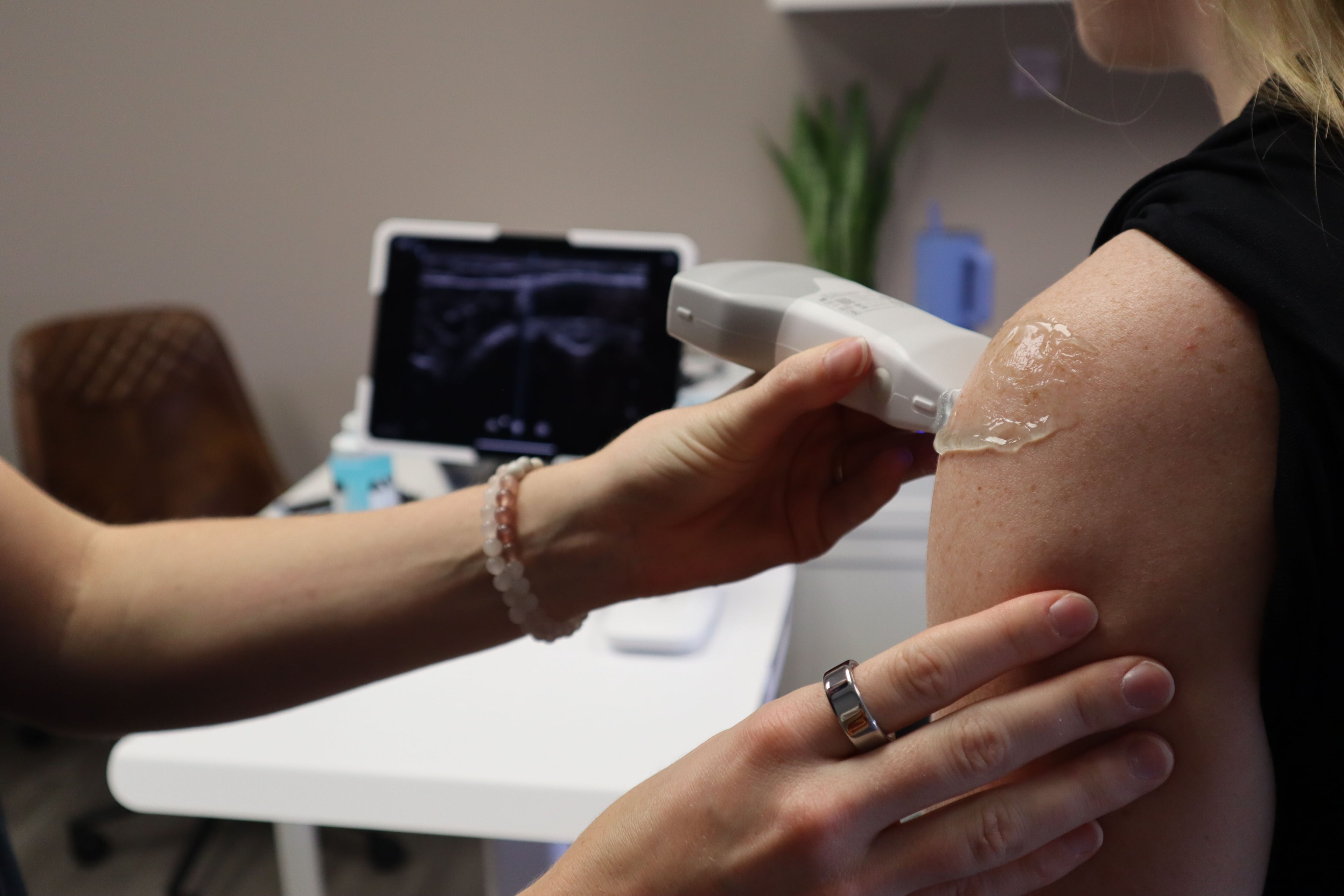
Point-of-care ultrasound, often shortened to POCUS. A portable machine, roughly the size of a laptop, used by your provider at the bedside during the visit. It answers one specific question quickly. Is there a clot in this leg. Is there fluid where there should not be. It takes minutes.
A full diagnostic ultrasound study. A sonographer captures a structured set of images, and a radiologist reviews them and writes a formal report. It is slower, usually half an hour or more of scanning, and it produces a document.
Both are real ultrasounds. They are not interchangeable, and a clinic advertising "ultrasound available" is usually talking about the first one.
Ours is a portable bedside ultrasound, and we say so plainly rather than implying a hospital radiology suite. What we add on top of it is the part that usually goes missing: STAT imaging reads within 3 hours and same-day scan results, so you leave with an answer rather than an appointment.
Why the report matters more than you would think
A bedside scan with no written report is genuinely useful for a clinical decision. Your provider looks, sees what they need to see, and treats you. For a lot of problems that is the whole story and you can stop reading.
It stops being the whole story the moment somebody else needs to see the result.
An insurance claim. An adjuster works from documentation. "The doctor looked and thought it was fine" is not documentation.
A work injury. Your employer's carrier will want a record, not a recollection.
A specialist referral. An orthopedist or a surgeon wants images and a read, otherwise you get scanned again somewhere else and pay for it twice.
So when you ask a clinic whether they do ultrasound, the more useful question is whether you will leave with something written down. If the answer is vague, that tells you what you need to know.
What an ultrasound is good at, and what it cannot see
Ultrasound uses sound waves rather than radiation. That makes it safe in pregnancy and safe for children, and it avoids the radiation dose you have to weigh up before a CT scan.
It is genuinely good at:
Soft tissue. Muscle and tendon tears, strains, collections of fluid, swelling that is not settling.
Blood clots, particularly deep vein thrombosis in the leg.
Gallstones, and signs of a blocked kidney, though a CT is better at pinning down a small kidney stone.
Ovarian cysts and early pregnancy questions.
Foreign objects under the skin, particularly wood, plastic and other material that an X-ray does not show at all.
It is the wrong tool for:
Broken bones. Sound waves do not travel through bone, so ultrasound sees the surface rather than the inside of it. X-ray is the standard test for a suspected fracture, and we do walk-in digital X-ray on site at all four locations.
Head injuries. If the concern is bleeding in or around the brain, ultrasound cannot answer it. That is a CT question, and we have written separately about whether urgent care can do a CT scan.
Anything hidden behind gas or deep behind bone. Bowel gas in particular blocks the view, which is one reason an abdominal ultrasound can come back inconclusive through nobody's fault.
Red-flag symptoms that require ER care
Do not wait for an ultrasound appointment if any of these are happening. Call 911 or go to the emergency room now:
Severe abdominal pain that will not ease, or an abdomen that feels rigid and board-like.
One-sided pelvic pain with a positive pregnancy test, especially with dizziness or fainting.
Heavy vaginal bleeding during pregnancy.
Chest pain or shortness of breath, particularly alongside a swollen or painful calf.
High fever with confusion, a racing heart, or a drop in blood pressure.
If you are unsure which way to go, our guide to urgent care versus the ER after a car accident walks through the decision.
If your pain follows a car accident
This is where ultrasound quietly earns its place, and it is the use case that almost every article on this topic leaves out.
The most common injury in a low-speed or moderate crash is not a broken bone. It is soft-tissue damage: strained muscle, torn or overstretched tendon, ligament injury, deep bruising. An X-ray looks straight past all of it, because an X-ray is designed to show bone. That is why so many people leave an emergency room with a clear X-ray, real pain, and no explanation. We have written about soft tissue injury after a car accident in more detail.
Ultrasound can look at exactly that tissue. It is not the answer to every post-crash question, but when the complaint is a swollen shoulder, a calf that hurts, or an area that is still tender two weeks later, it is often the right next step rather than a second X-ray.
Florida's 14-day PIP rule
If you were in a crash in Florida, there is a clock running that has nothing to do with how you feel.
Florida's Personal Injury Protection rules require you to be seen by a qualified medical provider within 14 days of the accident to access your PIP benefits. Those benefits reach 10,000 dollars only where a qualified provider determines you had an emergency medical condition. Without that determination, PIP medical benefits are capped at 2,500 dollars. The 14 days run from the date of the accident, not the date your symptoms started. That distinction catches people out constantly, because soft-tissue pain is exactly the kind that shows up on day four or day nine.
Miss the window and the benefit is generally gone, no matter how genuine the injury. Our page on car accident PIP exams and documentation covers what the visit needs to include.
"My X-ray was clear and I still hurt"
This is one of the most common things we hear, and it is worth saying plainly: a clear X-ray does not mean nothing is wrong. It means nothing is broken.
Those are different findings and they get collapsed into one sentence far too often. If you were told your X-ray was normal and you are still in pain a week later, that is not you imagining it and it is not a reason to give up. It is a reason to look at the tissue an X-ray cannot show, which usually means ultrasound or MRI depending on the area and the question.
Four things to ask before you drive over
"Call ahead" is advice everyone gives and nobody makes useful. Here is what to actually ask, in this order:
Do you have ultrasound on site today? Today matters. Some clinics have equipment but no one rostered to use it on a given day.
Is it a bedside scan or a full study? Now you know which of the two things above you are being offered.
Will I leave with a written result? The question that matters if an insurer, an employer or a specialist will ever need to see it.
If the ultrasound is inconclusive, can you do the next scan here? This is the one that saves you a second trip. An inconclusive ultrasound is common and not a failure. What you do not want is to start again somewhere else.
On that last point, we have X-ray and ultrasound on site, we offer same-day CT imaging, and we can arrange an MRI, so the follow-up scan does not mean a new referral and a new waiting list.
What an urgent care ultrasound costs
Cost is the thing nobody publishes, so here are our posted self-pay rates, listed openly on our pricing page:
Ultrasound: 150 dollars
X-ray: 70 dollars
CT scan: 200 dollars
MRI: 300 dollars
Office visit: 89.99 dollars
For comparison, a hospital ultrasound typically runs several hundred dollars and can be well over a thousand, depending on the scan and the facility. Prices change, so check the pricing page rather than taking these figures as permanent.
We also accept most insurance, including Aetna, Blue Cross Blue Shield, Cigna, Medicare, Medicaid, workers' compensation and PIP. If this follows a car accident, PIP is usually the payer rather than you. PIP covers 80 percent of reasonable medical costs, so check your own policy for the rest. That is what PIP is for, and it is another reason the 14-day window is worth taking seriously.
What to expect at the visit
Nothing about the scan hurts. Most scans need no preparation, but a gallbladder or abdominal scan usually means not eating for several hours beforehand, and a pelvic scan may need a full bladder, so ask when you call.
A provider takes your history and examines you first, because the exam decides whether an ultrasound is even the right test. If it is, warmed gel goes on the skin and a handheld probe moves over the area. A focused bedside scan usually takes five to fifteen minutes, and a full diagnostic study takes longer. There is no radiation, no needle and no dye.
You see the images as they appear and your provider talks through what they are looking at. Results are same day, with STAT reads inside 3 hours. If the scan raises a question that ultrasound cannot settle, we can go straight to X-ray on site, and arrange a same-day CT or an MRI from there.
The bottom line
Some urgent care clinics can do an ultrasound, most cannot, and the ones that can are often offering a quick bedside scan rather than a full radiology study. Neither is wrong. You just need to know which one you are getting, and whether you will leave with anything written down.
If you are in Palm Beach County and something is not settling, you do not need a referral and you do not need an appointment. Walk into any of our Lake Worth, Lantana, Palm Springs or Royal Palm Beach locations. If a crash is behind it, come sooner rather than later, because the PIP clock started the day of the accident and not the day it began to hurt. Our car accident injury clinic can see you the same day.
Frequently Asked Questions
Need Same-Day Care?
Skip the ER wait. Book an appointment or walk in today for expert medical care.